Autonomous AI Coding Agents Have Gone Mainstream
The headline story of 2026 in software engineering isn’t a new model — it’s a new kind of teammate. Autonomous coding agents no longer just suggest the next line; they pick up a real GitHub issue, explore the repo, write the fix, run the tests, and open the pull request. We’ve moved from “copilot” to “colleague.”
What the benchmarks actually say
On SWE-bench Verified — the widely cited benchmark of real-world GitHub issues — the numbers have crossed a line that mattered. Fable 5 now leads at a 95.0% autonomous issue-resolution rate. OpenHands (open-source, MIT, self-hostable) sits around 72% when paired with Claude, while Claude-class models resolve roughly 69% of repo-level issues versus the low-to-mid 60s for GPT-5.6 on the harder SWE-bench Pro.
But here’s the nuance the leaderboards hide: a July 2026 study (DeepSWE, DataCurve) found that real production tasks demand 5.5× more code and about 2× the output tokens than SWE-bench Pro prompts, even at half the prompt length. The benchmark is the easy part. Production is the gauntlet.
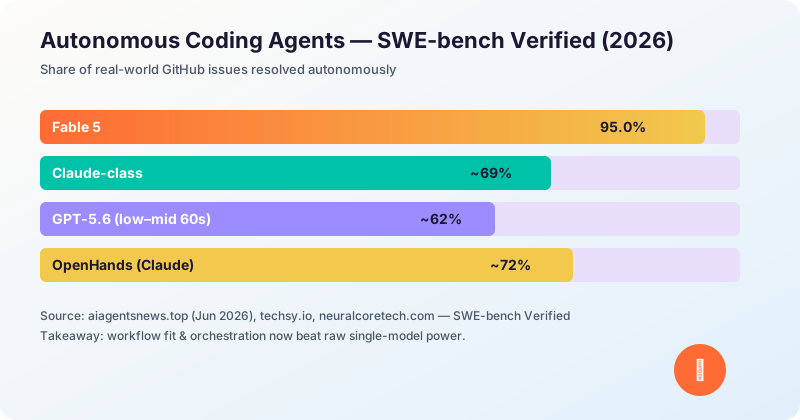
Workflow fit beats raw power
The most important shift this year is cultural: teams are realizing that orchestration matters more than model choice. A 95%-on-benchmark model wired into a brittle pipeline loses to a 72% model inside a thoughtful workflow — clear task scoping, deterministic test gates, human review on the merge, and a clean rollback path. The agent is only as good as the loop you put it in.
What this means for your team
- Start with the boring 80%. Let agents own issue triage, test generation, and routine refactors. Keep humans on architecture and security.
- Self-host where you can. OpenHands on your own GPU gives you control over code, cost, and confidentiality — no vendor telemetry on your IP.
- Gate everything. A non-negotiable CI check + a human approver on the merge turns “autonomous” from risky to reliable.
At Make In India Studio we run n8n-orchestrated agents for exactly this: scoped tasks, test-gated merges, and a human in the loop before anything ships. The craft isn’t in the model — it’s in the system around it.
Sources
- aiagentsnews.top — “AI coding agents: 2026 workflow fit beats raw power” (Jun 2026)
- techsy.io — OpenHands vs Devin vs Manus (2026)
- neuralcoretech.com — cross-vendor multi-model orchestration (2026)
- datacurve.ai — DeepSWE benchmark (updated Jul 25, 2026)